

Koi Fish Facts
Sky Predators
Oct
Koi fish are appealing prey due to their bright colors, which easily catch the attention of various avian hunters looking for an easy meal. Many predatory birds are well-adapted to catching fish, using their long beaks to spear them or their razor-sharp talons to grab them. Since your fish are confined, once a bird becomes aware of your Koi, it can be challenging to deter them. The best approach is to be proactive. Familiarize yourself with the birds that pose the greatest threat in your area and take measures to keep your Koi and Goldfish safe.
Wading Predators
Wading predators are ambush attackers. They hunt by sight and are incredibly patient. These birds will stand still or move slowly and methodically, wading from spot to spot and remaining motionless until your unsuspecting fish swim close enough to be caught.
Great Blue Herons
The great blue heron, as its name suggests, is characterized by its striking blue-gray plumage. These majestic birds stand approximately 4 feet tall and boast an impressive 6-foot wingspan, long yellow-green legs, and a pointed yellow bill. One of their distinguishing features is a prominent black stripe that forms a plume extending from above their eye to the back of their long, flexible neck, which they typically hold in an “S” shape.
The great blue heron is one of the most formidable predators your Koi or Goldfish pond may encounter. They spear their prey and swallow it whole, and are capable of gulping down fish up to 7 inches in length, at up to a pound each day. While they prefer feeding during the early morning and at dusk, they will hunt confined prey at any time for an easy meal.
A variety of aquatic environments across North America and the Caribbean are home to herons. They inhabit both saltwater areas, such as coastal marshes, swamps, and beaches, as well as freshwater locations, including ponds, lakes, rivers, and streams. Some subspecies even thrive in grassy or urban areas. If you live in northern states where ponds freeze over in winter, you may enjoy a reprieve from herons. However, in milder and warmer climates, these birds can pose a year-round threat to your pond.
Herons can hunt in various water depths but tend to favor the shallow areas. To deter these predators, consider adding graduated slopes to your pond and increasing its depth. Another way to deter the great blue heron is to place heron decoy statues around the pond. Since herons are territorial, if one spots another in or around a body of water, it is likely to move on and search for a different feeding spot.
Great Egrets
The great egret is a member of the heron family and stands about 3 feet tall, with an average wingspan of 5 feet. It is slightly smaller than the great blue heron, but it is even more agile. This bird is recognized for its striking appearance, characterized by a completely white, feathered body, a yellow-orange bill, and black legs. However, pond owners often view egrets as far less charming than casual observers do.
Using its long, flexible neck and dagger-like beak, the great egret hunts by stabbing its prey and swallowing it whole. No fish smaller than 6 inches is safe from its grasp. Its hunting habits are quite versatile–egrets may feed alone or in groups. While they typically prefer areas with shallow water, they also roam grassy fields, where they can catch insects and small mammals.
Great egrets are widespread across much of the globe, but they are most commonly found in Europe, Africa, Asia, and the Americas, with a notable presence in North America, particularly in the southeastern U.S.. Warmer, more humid climates attract a diverse range of prey, including amphibians, reptiles, and fish.
Like the great blue heron, a key indicator that an egret has visited your pond is the noticeable absence of fish. Egrets are clean eaters and leave little evidence of their presence (aside from a depleted pond). Occasionally, during their molting cycle, they may shed a few feathers, but in general, the water conditions and surrounding area of your pond will remain undisturbed after an egret attack.
Netting and pond covers can serve as physical barriers that help keep great egrets away from your pond, although they may not be the most aesthetically pleasing option for many Koi keepers. Egrets have sensitive feet, so surrounding the pond with pebbles can deter them, as they will find the texture uncomfortable. Additionally, egrets are sensitive to loud noises, so playing a radio or creating other loud sounds can make them less likely to target your pond.
Diving Birds
Diving birds hunt by visually tracking their prey from the sky, then folding their wings back and plummeting at high speeds into a precision attack. The momentum propels them underwater, where they snatch their prey. Specialized muscles in the neck protect against injury during high-speed dives, with some species reaching speeds of more than 100 mph.
Belted Kingfishers
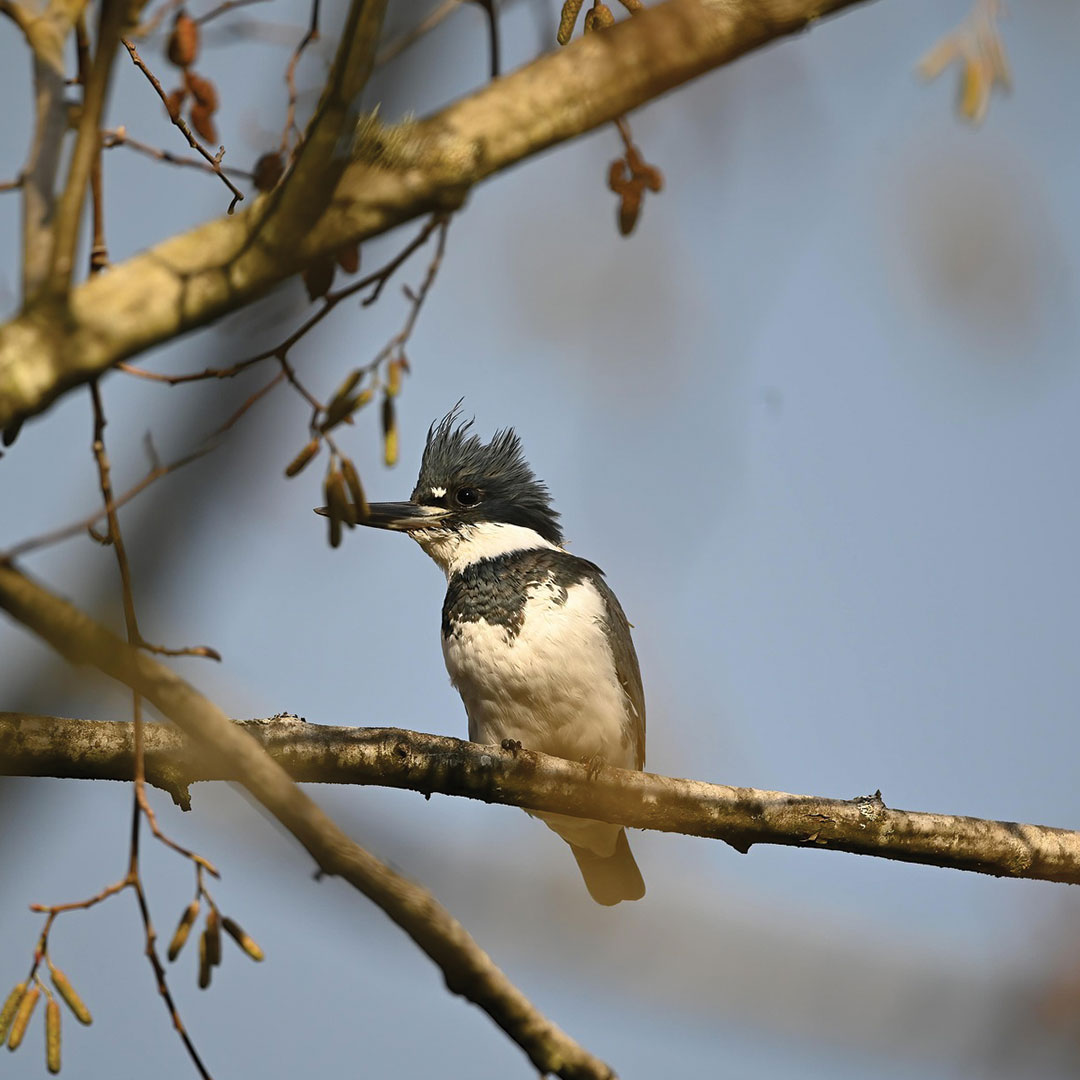
Kingfishers are among the smallest diving birds, measuring about 1 foot in length with a wingspan of 2 feet. They possess a stocky build, characterized by large heads, fluffy crests, and long, thick bills. Their plumage is primarily blue-gray, adorned with white spots on their backs and a noticeable white collar. Males have a blue-gray chest band, while females have a reddish-brown belly. Both sexes have white underparts and a square-shaped tail. Despite their small size and charming appearance, kingfishers can significantly disrupt your pond.
Belted kingfishers are found in both inland and coastal areas across North America. These migratory birds travel to southern states, Mexico, and the Caribbean during the winter months. In warmer, wetter regions, they can be seen year-round. Kingfishers typically hunt for their prey from nearby tree branches, making treelined backyard ponds prime spots for them to visit.
As predators, belted kingfishers swoop down to catch fish with their beaks. Although they are not as fast as herons, they often target Koi, particularly juvenile fish, making them a considerable threat to your pond. If your pond also contains Goldfish, it is at an even greater risk, as these smaller fish are perfectly sized kingfisher prey.
To help prevent predation, consider deepening your pond and adding plants, rocks, and shelves to reduce visibility. These birds rely on sight to hunt, so providing hiding spots for your fish to escape plain view is helpful. If you live in an area frequently visited by kingfishers, you might choose to keep only mature fish in your pond, as fully grown Koi are generally beyond the reach of belted kingfishers.
Ospreys
Ospreys are distinguished by their white and brown plumage and a distinctive single stripe on each side of their heads. Their claws are specially designed for grasping and maneuvering prey. Notably, they have a reversible outer toe that allows them to grip with two toes in front and two behind, enabling them to reposition their catch into a streamlined position for easier flight. Instead of eating their meals immediately, ospreys typically fly to a nearby perch or their nests to consume their catch. They measure about 2 feet in length and possess a massive wingspan that can exceed 5 feet, making them quite conspicuous to pond owners.
Chances are, no matter where you live, you aren’t far from an osprey. They inhabit every continent except Antarctica and are commonly found near various bodies of water, including oceans, rivers, lakes, marshes, and coastal wetlands. Even ponds in arid areas aren’t entirely safe, as ospreys will stop by while migrating toward wetter regions. You are most likely to see ospreys visiting your pond if you live in Florida or anywhere along the Atlantic coast.
Of all the raptors, ospreys (also known as fish hawks) pose the greatest threat to Koi. They often hover above their prey before swooping down to catch it with their feet. Ospreys can completely submerge themselves, closing their third eyelids, a transparent membrane that aids their underwater vision. Unlike opportunistic hunters who are content with any meal they find, ospreys specialize in catching fish, typically targeting those up to 16 inches long. They will eat any Koi they can catch and carry, often discarding leftover portions rather than consuming the entire meal.
Ospreys have excellent eyesight and can spot brightly colored pond fish from a distance, which makes them particularly attracted to your pond. To deter these hunters, you can create sight barriers. Planting abundant surface vegetation in your pond and creating water disturbances with an aerator or waterfall can help your fish go unnoticed. Additionally, physical barriers such as netting, monofilament lines, or interlocking plastic rings can prevent ospreys from attacking your fish.
Red-Tailed Hawks
Of the many types of hawks, the most common one you may spot at your Koi pond is the red-tailed hawk. Despite its height of approximately 2 feet and a wingspan of 4 feet, this hawk is surprisingly light, weighing typically less than 3 pounds. Like other hawks, it has a sharp, curved beak that allows it to tear apart its prey, along with large claws featuring four talons each to capture and hold onto its food while flying to a preferred eating spot. The bird’s plumage consists of varying shades of brown, accented by a distinctive reddish tail.
Red-tailed hawks are found across North America. They prefer areas with open spaces for hunting but have adapted to various environments, including urban settings. Their diets typically consist of reptiles, rodents, and smaller birds and mammals, with fish being a much less common food source. While they can target Koi or Goldfish, they pose a smaller threat than herons, egrets, or ospreys, since fish are not their preferred prey. Though they prefer forested areas, red-tailed hawks adapt well to human habitats and are generally not fearful of people. As a result, once they discover your yard, they are likely to visit frequently.
When flying, hawks are usually not hunting–they prefer to track their prey from a nearby perch. They swoop down to capture their prey with their large claws and four sharp talons, which they use to kill it before utilizing their strong, razor-sharp beaks to tear away the meat. Similar to ospreys, red-tailed hawks carry their prey to a perch or nest before eating. In the case of larger prey, such as a mature Koi, they may eat directly on the ground.
Hawks are visually stimulated, so creating optical illusions and obstructing their view can be effective methods of deterring them. Shiny objects can confuse and scare hawks, so consider hanging items, like old CDs, from stakes around the pond to reflect light. Additionally, using pond covers, increasing the number of surface plants, and creating hiding spaces can help reduce the likelihood of detection. It’s also important to note that hawks are attracted to areas with abundant prey. Reducing or eliminating the populations of small animals like mice, squirrels, chipmunks, frogs, and lizards can make your yard less appealing to red-tailed hawks.
Barred Owls
Barred owls are easily recognized by their distinctive plumage, which features a mix of dark brown horizontal and vertical bars across their chest, contrasting with their beige feathers. As nocturnal hunters, these birds can be challenging to spot at night, but their unique hooting calls are hard to miss. They measure about two feet in length, with a wingspan that can exceed four feet.
Typically, barred owls are non-migratory and inhabit the eastern half of the United States, from north to south, as well as the Pacific Northwest. Pond owners in urban areas generally don’t need to worry about them, as these owls prefer large, unfragmented forests and woodlands. In rural and suburban areas, they tend to inhabit regions near rivers, swamps, and streams.
Like other owls, barred owls primarily feed on small land animals. However, they are more likely to target Koi fish ponds, as their diet includes fish, mollusks, and crustaceans. Being nocturnal, they mainly pose a threat to ponds at night, particularly just after sunset, when they prefer to hunt. Barred owls usually swoop down from a nearby perch to catch their prey with their large talons, and they may even wade into shallow waters to hunt.
To deter barred owls from your pond, it’s best to remove their physical and visual access. Trim overhanging branches to limit potential launch points, utilize surface plants and other water features to make it harder for the owls to see your Koi, and install amber or red-colored lights near your pond. Such lighting reduces the contrast that barred owls can detect, making it more difficult for them to spot their prey.
Double-Crested Cormorants
The double-crested cormorant is a bird roughly the size of a goose, known for its speed and agility. From a distance, these birds appear completely black, but a closer look reveals their orange skin, turquoise eyes, bright yellow at the base of their beaks, and blue mouths. During the breeding season, double-crested cormorants develop tufts of feathers on either side of their heads, which is how they got their name.
As opportunistic predators, cormorants feed on a variety of fish, crustaceans, and amphibians, primarily targeting those that are easiest to catch. They exhibit behaviors characteristic of both waders and divers. The birds scout from the surface of the water and can dive up to 20 feet deep to capture their prey. They use their hooked beaks to spear their food and bring it to the surface to swallow whole. Like other wading predators, double-crested cormorants can consume up to a pound of fish each day.
These migratory birds are highly adaptable, enabling them to thrive in a wide range of habitats, from large reservoirs to small inland ponds, spanning areas from southern Alaska to Mexico. As a result, almost no pond owner in the United States is outside their range. They also breed extensively in the Great Lakes region and in Florida.
Cormorants have a remarkable ability to identify and remember ponds. Once they find a fish haven, they tend to return frequently, often feeding while the pond owners are away at work, particularly before lunchtime. They will continue to fish there until they have depleted your stock.
Deepening your pond won’t deter cormorants as it might with other wading birds, since their streamlined bodies and webbed feet allow them to dive far underwater. However, using decoys that resemble natural predators, such as alligators or great horned owls, can be effective in deterring these birds.
Protecting your Koi and Goldfish from sky predators requires both awareness and proactive measures. From patient wading hunters, like herons and egrets, to agile divers, such as kingfishers and ospreys, each bird brings unique challenges to pond owners. By understanding the habits, adaptations, and hunting techniques of these predators, you can better anticipate their presence and implement effective deterrents. While it may be impossible to eliminate every threat, thoughtful planning and consistent vigilance will greatly increase the chances of keeping your pond a safe and thriving environment for your Koi and Goldfish.